
23.11.26 | Oliver Egger

Every push to a FHIR implementation guide on GitHub triggers the FHIR IG auto-builder, which posts the commit message to the #ig-build topic on chat.fhir.org. Looking at these notifications, at least 12.5 % of the IG commits in October 2026 were explicitly written or co-authored by an AI agent (Claude, Copilot, Codex, …), up from under 1 % a year earlier. Counting the commits without a marker that are written in the typical agent style, it is close to 20 %.
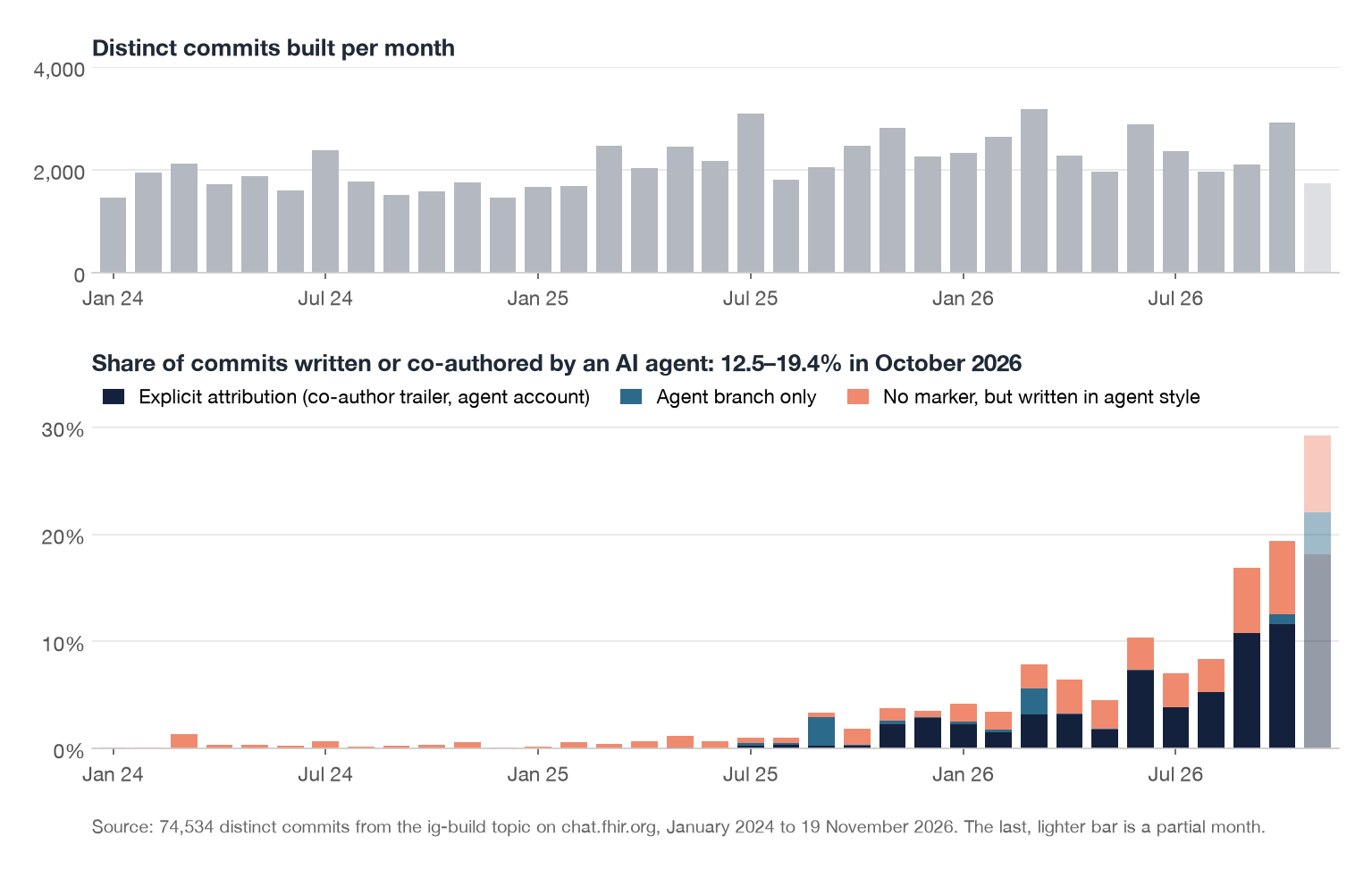
Analysis: interactive version with the monthly numbers and how they were counted
I showed these numbers last week at the HL7 Europe Working Group Meeting in Málaga, in the tutorial «Maintaining FHIR IGs with AI Agents: From Chat to Harness to Cloud».
Slides (PDF): Maintaining FHIR IGs with AI Agents
From chat to harness
On its own, a language model only completes text: it can write a plausible FSH profile, but it cannot run SUSHI, read your repository or look up a code. An agent becomes useful through the harness around it, such as Claude Code, Codex CLI or GitHub Copilot agent mode. The harness runs the model in a loop: the model chooses the next step, the harness runs the tool call, and the result goes back to the model, until the task is done.
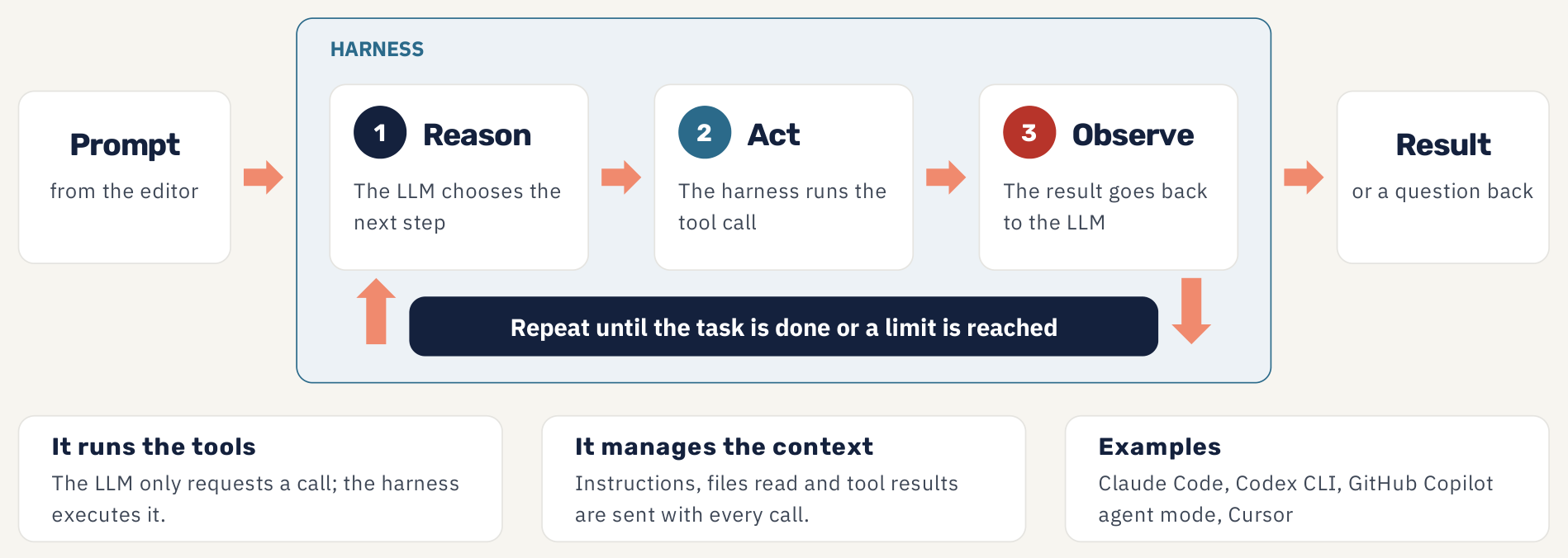
For IG work, the tools are the ones editors already use: the files in the repository, SUSHI and the IG Publisher on the command line, and MCP servers for validation with matchbox and for terminology lookups. SUSHI and the QA report of the IG Publisher give the agent a check it can run, so it keeps working on a change until the build is clean. The modelling decisions, such as cardinality, must-support and binding strength, stay with the editors, and a human still reviews the diff, not only the QA result.
In the demos, three prompts were enough to create and publish the agentic-ig, a demo IG about maintaining IGs with agents, and an agent running in GitHub turned issues into pull requests.
What works for you?
I would like to collect what works in practice:
skills, prompts and AGENTS.md / CLAUDE.md files you use in your IG repositories,
tools and MCP servers (validation, terminology, FSH/SUSHI, IG Publisher, QA review),
workflows that worked well, and ones that did not.
We started collecting this in the agentic-ig implementation guide, with a catalogue of what is available today. If you have something to share, please add it with a pull request or an issue on GitHub, or reply in the thread on chat.fhir.org.
Thank you to everyone who joined the tutorial in Málaga and shared their experiences in the discussion.
Disclosure: ahdis develops matchbox.