
17.11.26 | Oliver Egger

How do you know your FHIR implementation really works with others? At the HL7 Europe Working Group Meeting in Málaga I gave the tutorial «Testing FHIR implementations: from validation to test scenarios». With the European Patient Summary as running example, we went from validating a document, to testing a system against a simulator, to test scenarios that combine several tools. We closed with a discussion on how testing works within Europe.
Slides (PDF): Testing FHIR implementations · Hands-on material: github.com/ahdis/fhir-testing-tutorial
The testing ecosystem
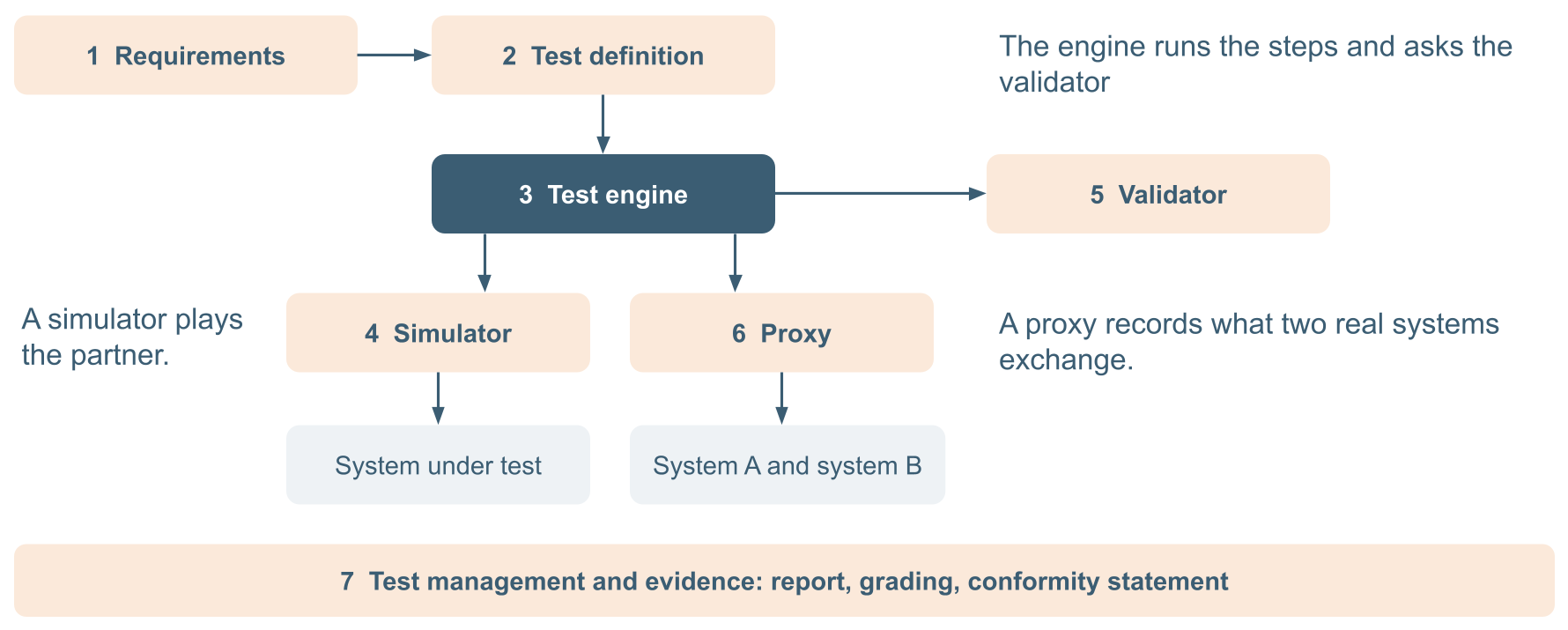
Most testing tools are built from the same blocks: requirements and test definitions, a test engine, a validator, a simulator that plays the partner, a proxy that records what two real systems exchange, and test management that turns the results into evidence.
The tools
In the hands-on part, every step is one script you can run on your own laptop:
the HL7 FHIR validator on the command line,
matchbox, the same validation engine as a service,
the EU Interoperability Test Bed (ITB), with matchbox as its validator and as a simulator for the EU Health Data API, and
Gazelle with its new execution engine Maestro, which chains matchbox and ITB into one test run with one report.
The slides also give an overview of Inferno, Interoplab, Touchstone, FHIR Frog, TestFhiry of HL7 Austria and other tools that run FHIR TestScripts.

Your input is welcome
The tutorial material is open and still evolving. If you try it and something does not work, if a tool is missing or you see things differently, please open an issue on GitHub.
Thank you to everyone who joined in Málaga, brought their laptops and took part in the discussion.
Disclosure: ahdis develops matchbox.