
Digital Health Terminology service in Switzerland
12.12.25 | Oliver Egger

Introduction
DigiSanté announced that the national FHIR terminology server will be the first basic service in the Swiss Health Dataspace (SwissHDS). Terminology is an important pillar of any interoperable healthcare system. According to the State of FHIR in 2025 survey, terminology services are the second-most cited use case for using FHIR, with roughly half of all respondents already having a national FHIR terminology server in production or in development in their country.
In this post, we do a deep dive into the current terminologies used in Switzerland. We look at the current terminology for the development of implementation guides (IGs) and discuss how the future FHIR terminology service will support applications and users in the Swiss Health Dataspace (SwissHDS).
Terminologies for digital health interoperability
A standardized medical terminology is a structured and systematically organized set of terms, concepts, and codes. It is used to describe clinical conditions, procedures, medications, and other related topics in a consistent and uniform manner.
On an international level, a number of different terminologies are being developed and maintained, including:
SNOMED CT
Systematized Nomenclature of Medicine – Clinical Terms (SNOMED CT) is the most comprehensive clinical terminology globally, with widespread clinical adoption still in progress as part of broader digital health transformation efforts. For example, the allergy intolerance exchange format for the Swiss EPR uses SNOMED CT Value Sets for substance coding. Each country must secure a license to use SNOMED CT, but may add its own extensions and translations thereafter in a country specific extension. In Switzerland, eHealth Suisse has been the national release center for SNOMED CT since 2016. SNOMED CT has a special release format for editions and extensions issued by eHealth Suisse. The terminology can also be queried through a browser.
LOINC
Logical Observation Identifiers Names and Codes (LOINC) is a universal standard for identifying medical laboratory observations. First developed in 1994, it was created and is maintained by the Regenstrief Institute in the United States. Switzerland was an early adopter of LOINC — implementing it as early as 2001— and as part of the Swiss Personalized Health Network (SPHN) project, L4CHLAB mapped approx. 1,500 laboratory analyses to LOINC across Swiss university hospitals. However, current use faces challenges, including incomplete mapping and language translations, and laboratories using their own internal coding. Recently, the FHIR CH ELM exchange format developed by FOPH has enabled laboratories to electronically send observations of notifiable communicable diseases, with information coded in LOINC and SNOMED CT. The LOINC codes are distributed in a CSV file or can be queried through a search form.
ICD 10/11
Switzerland uses ICD-10-GM for diagnosis coding. The Swiss Federal Statistical Office (BFS) adopted the German modification, with translations into French and Italian. The Code System is available through CSV, ClaML, and PDF formats, or in JSON/CSV on I14Y.
UCUM
Unified Code for Units of Measure (UCUM) is a Code System intended to include all units of measure that are currently used in international science, engineering, and business. UCUM is both a Code System of atomic units of measure (g, mg, etc.) and a syntax standard for how to represent pre-coordinated units of measure (g/mL, mg/dL, etc.). UCUM also provides the computational foundation to convert like units of measure by providing multipliers: for example, converting mg/dL to g/mL.
THO
HL7 Terminology (THO) comprises the Code Systems and Value Sets cited in HL7. It includes published artifacts in browsable form and as an FHIR Implementation Guide, in NPM Package Format.
At the national level, Switzerland also maintains several country-specific terminologies:
CHOP
The Swiss Classification of Surgeries (CHOP) is managed by BFS in German, French, and Italian. The codes are available in CSV format or JSON on I14Y.
Variables for medical statistics
BFS defines variables for medical statistics in German, French, and Italian. The variables are provided in PDFs.
eCH codes
The Swiss eCH Association promotes, develops, and adopts eGovernment standards. Swiss-specific codes — for example, for sex, marital status (eCH-011), or communication categories (eCH-0046) — are defined within eCH standards. The codes are defined in the schema files, with descriptions provided in accompanying PDFs.
Swiss country codes
Although two-letter country codes are defined internationally by ISO 3166-1, there are also country codes that are not internationally used under ISO 3166-1. Kosovo, for example, is designated as XK by Switzerland and others but is only part as a user assigned code in the ISO standard. This information is available through the BFS, together with the official translations in an XML or Excel download.
Swiss Value Sets and mappings in the EPR
For the Swiss EPR, Value Sets and mappings for medication, allergies and intolerances, and vaccinations are defined for Document Sharing Metadata and FHIR-based exchange formats. These Value Sets are available as PDF (annexes), as SVS files, or directly in a FHIR IG.
As discussed, the terminologies have different export formats, including unstructured PDFs, CSV and Excel files, and highly specific formats like CACML or R3. This makes it hard for software applications to work with those terminologies in a unified way. A common way to access these terminologies is needed.
Interoperability of terminologies
FHIR is the newest generation of HL7 standards and is gaining worldwide adoption for interoperability in healthcare. With general concepts (resources and APIs), it also defines resources to represent, distribute, and query terminologies independently of the structure of the terminology module.
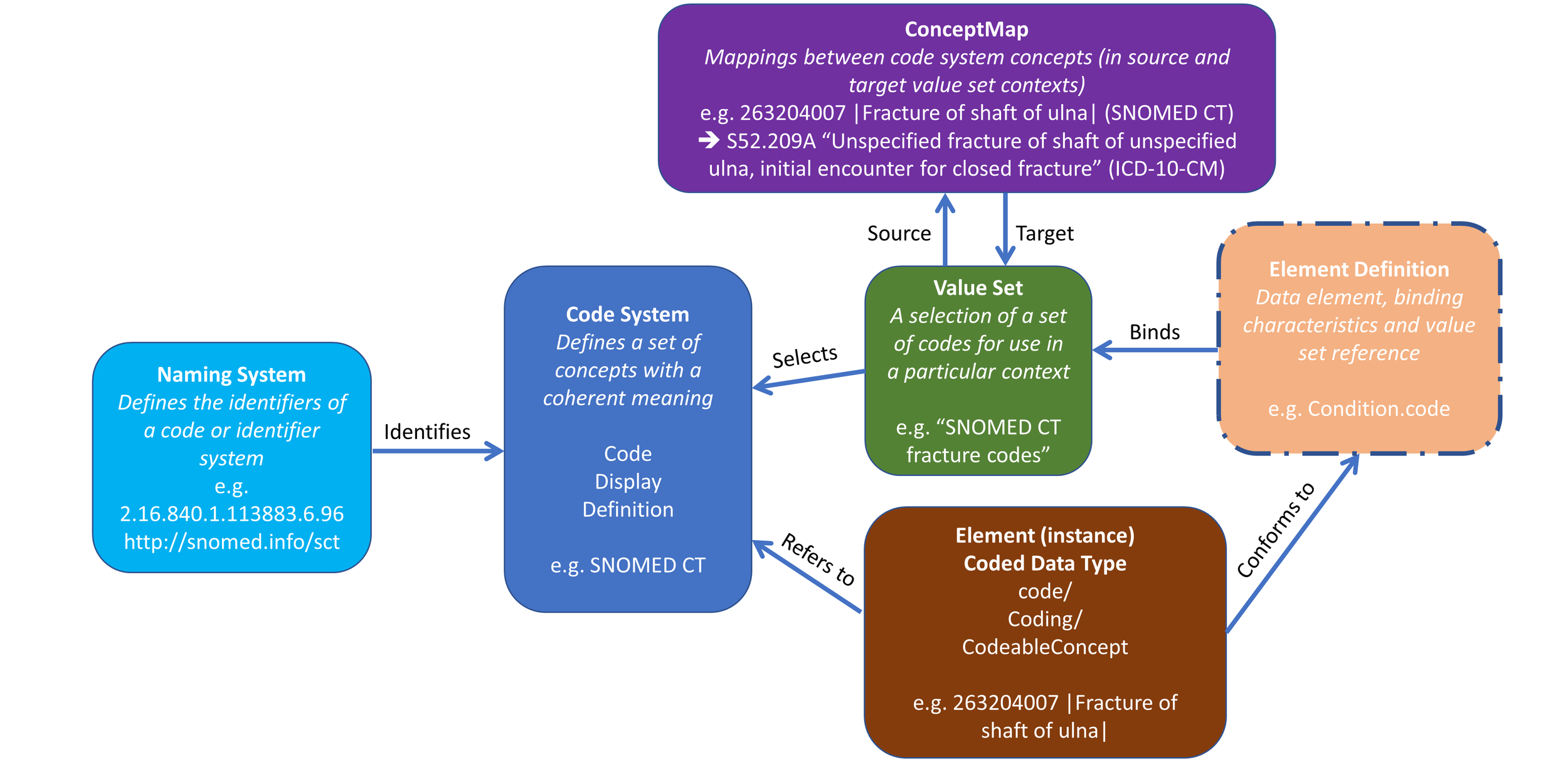
Example: SNOMED CT fracture codes ValueSet representation in FHIR. Source: hl7.org
FHIR distinguishes among the following:
CodeSystem: Describes key elements of a terminology.
ValueSet: Identifies a set of codes from one or more CodeSystems that is used for a specific purpose. ValueSets can be defined along hierarchies.
ConceptMap: Defines a mapping between one or more concepts in one Code System to one or more concepts in another Code System.
FHIR also defines a terminology API to support common use cases for querying terminologies, including validating a code, looking up display names or translations, expanding a ValueSet, and translating a code from one ValueSet to another.
Those terminology services support users by providing:
Accessibility: a unified view of all terminologies in a jurisdiction, or at the global level
Publication: Correct codes and ValueSets for publication in interoperability specifications
Validation: Verification against implementation guide requirements during publication, testing, and production
UI dropdowns: valid coded values and type-ahead functionality to populate selection lists
Code search: location of codes by name or description in large terminologies like SNOMED CT
Cross-mapping: translation between local and international terminologies
Display names: human-readable labels for codes
Analysis: mappings and relationships between codes
Different providers of terminologies offer a terminology service directly:
Snowstorm by SNOMED International (as a public instance for demonstration, non-production use only).
These are independent services. For projects involving multiple terminologies, dedicated terminology services are needed. One such use case is for creating FHIR Implementation Guides; for example, CH ELM uses LOINC, SNOMED CT, and UCUM codes for the notifications. To support this, HL7 International provides a terminology service covering international terminologies for IG development.
Terminology service for creating FHIR implementation guide specifications
HL7 offers its members a reference terminology server on tx.fhir.org for development use. There are no SLAs, which prevents production use.
HL7 does not host national terminologies such as the Swiss SNOMED CT extension. This is why HL7 affiliates or countries need to have their own terminology server for country-specific terminologies, which can then be added as an authoritative source for those national terminologies.
The current list of federated FHIR terminology servers can be found here. To be accepted as a terminology server, you need to pass a test suite. In addition to the reference terminology server ontoserver has passed all the tests.
To use these terminology services, publishers need to provide their terminologies in a machine-processable format.
The terminology ecosystem in Switzerland
Currently, Swiss terminologies are published by different federal agencies and organizations in a variety of formats, including PDF, CSV, Excel, and FHIR Implementation Guides.
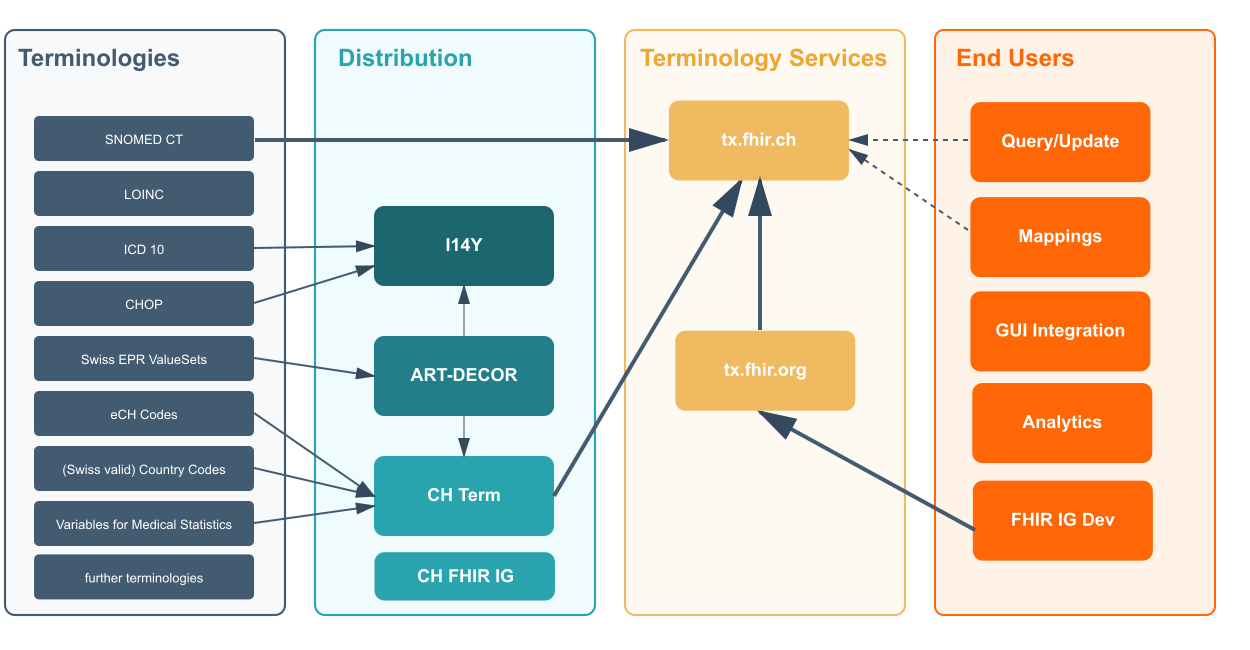
Publication and distribution of terminologies in Switzerland
For example, in the Swiss EPR, the confidentiality code for documents has been fixed to three codes: ‘Normal’ and ‘Restricted’ from SNOMED CT, and ‘Secret’ from the Swiss SNOMED CT Extension. The FOPH defines this ValueSet in the EPR SR 816.111 Annex 3 as a PDF; eHealth Suisse manages the codes with additional language translations on art-decor, where they can be exported in FHIR ValueSets or other formats. The Swiss EPR also defines required mappings between document types and categories, which are also defined in Annex 3, with the mapping also defined in art-decor.
The I14Y interoperability platform is Switzerland’s national metadata catalogue. Authorities can describe their data sets, electronic interfaces, and public services using metadata, thereby making them searchable. The metadata of the Valuesets are already published by eHealth Suisse on the I14Y platform. In the future, the codes can be added directly; however, the publication of the code mappings to other codes is not yet possible with I14Y.
HL7 Switzerland currently exports the art-decor Swiss EPR ValueSets and mappings to the CH Term FHIR Implementation Guide. Valuesets for the different exchange formats are also maintained in CH Term by HL7 and eHealth Suisse.
To support the publication of Swiss FHIR Implementation Guides according to HL7 rules, RALY GmbH has set up tx.fhir.ch for HL7 Switzerland based on the terminology reference server. tx.fhir.ch supports the SNOMED CT Swiss Extensions and CH Term and is an authoritative server for tx.fhir.org.
With this set-up, Switzerland has limited functionality, with no production use, and no use cases other than FHIR development. In addition, CH Term becomes outdated because there is no direct update if the underlying terminology changes. The current set-up does not allow all the terminologies to be queried because they are not in a format that can be imported. When additional terminologies are available, like Value Sets defined by other projects (for example, CH ELM for notifiable diseases), they cannot be queried or searched.
Vision for a future terminology in the Swiss Health Data Space
With the announcement by DigiSanté that the national FHIR terminology server will be the first basic service in the Swiss Health Dataspace (SwissHDS) those problems can be addressed. Among other things, it will enable the import of SNOMED CT and ValueSets from the EPR.
A possible future terminology set-up in Switzerland could function as follows:
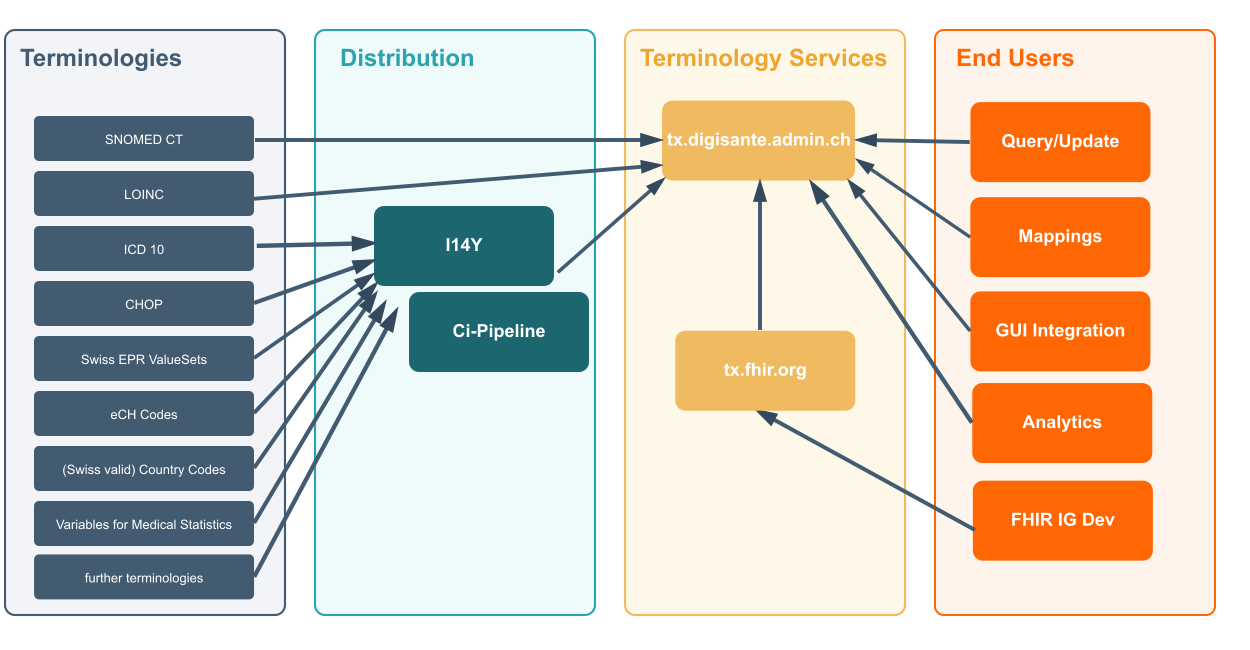
Future publication and distribution of terminologies in Switzerland
All terminologies would be registered in I14Y, which would accept FHIR terminology IGs as input, extract the required metadata, and provide it to the terminology server. For non-FHIR-based terminologies, a CI-build pipeline would transform the content for the terminology server. Alternatively, an editor could allow direct definition of coding, although this presents risks of errors and out-of-sync data.
A few important points need to be addressed in this process:
Assigning a unique identifier for each terminology independent of the language, as currently official FHIR canonical URLs for CHOP and variables for medical statistics, among others, are missing.
Providing an environment where terminology owners can update and maintain their terminologies and create exports which can be imported into the terminology service (combination of CI-Pipeline, I14Y and maybe editing capabiliies).
Providing and maintaining a national terminology server for production use, with responses within milliseconds.
On a technology level, Austria has provided TerminoloGit tooling to make terminologies in FHIR IGs available. France has set up a production terminology server for the whole health ecosystem. The pieces are there, and with the DigiSanté initiative, Switzerland should soon be able to catch up and provide a national terminology service for the relevant terminologies.